
My best ideas tend to work their way into my brain late at night as I’m drifting off to sleep. I’ve learned that no matter how revolutionary an idea might be, I will not remember it unless I write it down.
So I force myself to open up my heavy eyes and jot my best ideas down in the notes app on my phone.
The problem is, when I look back on these notes, I never know exactly what Past-Me meant. I’m typically half-asleep when the ideas form, and my notes are never detailed enough to jog my memory.
For example, these three cryptic ideas are in my notes right now:
- Coupon Crabs
- Pap’s Bagel Shop
- Clumps!!!
What do these mean?
Do I attempt to trace back through my thoughts to try to remember exactly what Past-Me was thinking? Or do I just move on?
But I know Past-Me pretty well. And I know that if he’s not positive that his idea is absolutely brilliant, he won’t muster the energy to write it down, and will just allow himself to go to sleep.
So how do I retrace my thoughts to find the same confidence and enthusiasm around each of these ideas?
Through the years, I’ve developed my own method, The Thought-Tracing Tree™, and have found that it not only helps retrace thoughts, but can be a great tool to develop new ideas.
Climbing the Thought-Tracing Tree™
Imagine a tree inside of your brain that your thoughts can climb.
Starting at the bottom of the tree, the trunk, is the main idea. As your thoughts climb, they move away from the trunk and across branches in many directions, as ideas branch off of the main topic.
The thought will continue climbing and moving outward onto thinner and thinner branches until it is so far away from the trunk that it reaches a dead end and is no longer related to the main idea.
When using the Thought-Tracing Tree™ to retrace a thought that has already climbed, we can work backwards.
Let’s use Coupon Crabs from my idea list as an example.
Starting with the main idea, Coupon Crabs, on the trunk, I let my thoughts branch outwards to a few things that I could’ve meant.
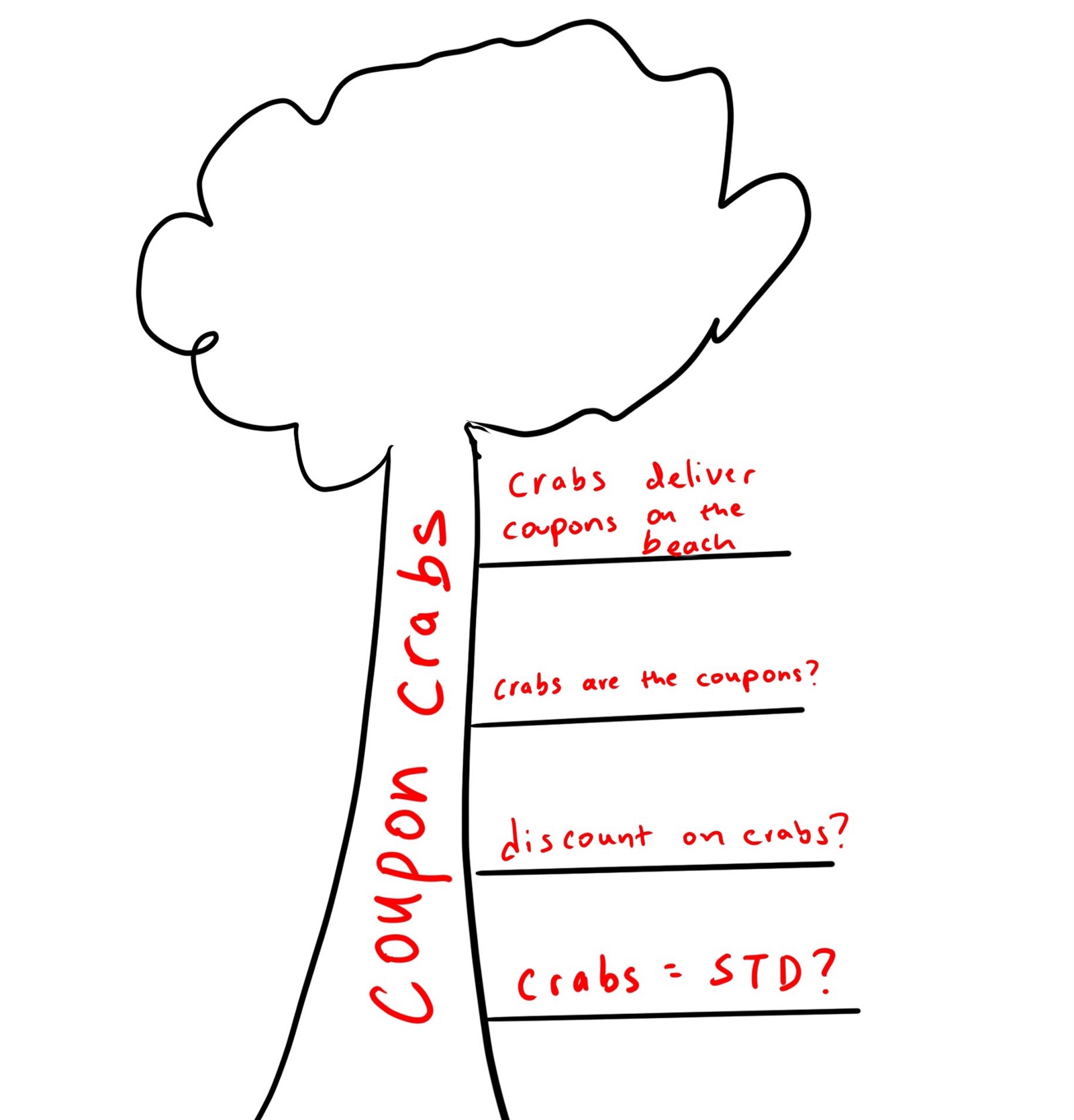
My thoughts will continue climbing outwards as far as they can from each of these branches until I end up somewhere that jogs my memory or hit a dead end that is no longer connected to the main idea.
More often than not, this technique will work, and more often than not, the original idea was not near as brilliant as I had hoped.
In the case of the Coupon Crabs, the tree worked its magic in jogging my memory.

My idea was to train a team of crabs to use their pincers and cut out coupons for elderly arthritic people who struggle with scissors.
Is this a brilliant idea? Maybe.
Am I going to write about it? Probably not.
I ran the same exercise with the next idea on the list — Pap’s Bagel Shop, and very quickly I traced the original thought.
Pap’s Bagels would serve homemade specialty cream cheese, Pap’s Schmear.
That was it.
That was the whole idea.
Using the Thought-Tracing Tree™ for Ideation
The final idea in my notes, “Clumps!!!” is extremely vague and can lead me in many different directions, making it less likely to be able to trace my original thought.
Clearly this was a great idea because I used three exclamation points, but after attempting to climb the tree for several hours, no branches were leading me to familiar territory.
There were branches, however, that led into new territories, and new creative ideas that were sprouted.

This same exercise can be used with any word or phrase to create new ideas about any topic.
It’s actually an amazing tool to use as a writer.
Be weary though of branching out too far. If you’re unable to fluidly return to the main topic, then you’re too far gone. The branches are merely twigs and they cannot support the weight of your thought.
If I wanted to write the “Clumps!!!” article but allowed the thoughts to climb all the way to cocaine cubes, it would be very difficult to tie back to the main topic and write a coherent piece.
But, in straying away, the tree helped me find new ideas. I could now plant a whole new tree with Sugar Cubes as the trunk, and let these thoughts climb from there without being terribly off topic.
A Thought-Tracing Tree™ Ception
I’ve thought about the Thought-Tracing Tree™ a lot, and have allowed my thoughts to climb the branches many times. I’ve used the tree as a tool to remember many overhyped ideas and to develop new creative ideas.
But in order to fully illustrate its power, I’ve assembled a Tree Diagram about the Thought-Tracing Tree™ that turned into this article.
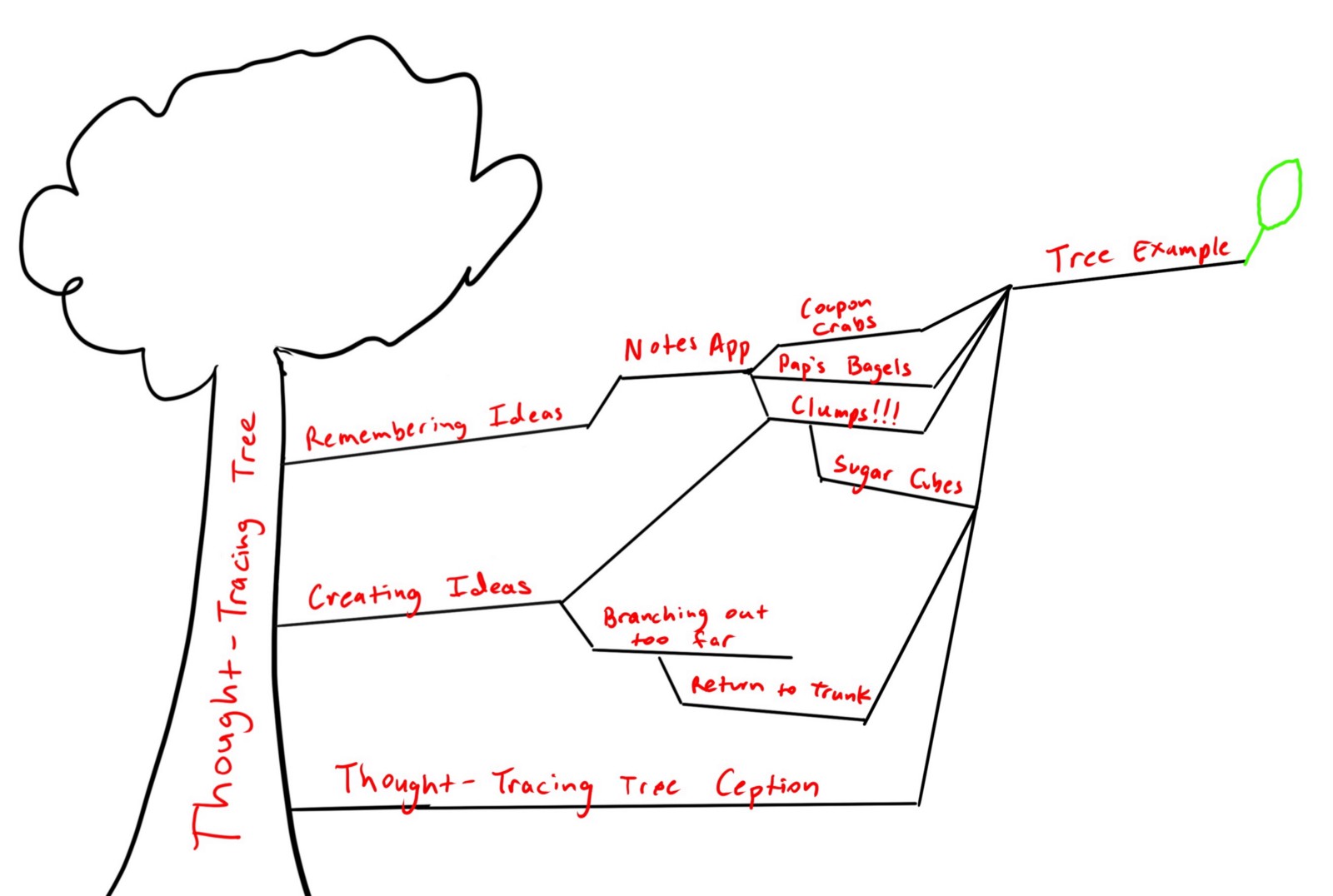
Hopefully these semi-satirical tactics can be helpful to other writers in remembering ideas or thinking of new ones.
 I Just Realized Something